NFT Copyright Explained
Understanding NFT Copyright and what you actually get (rights) when purchasing an NFT.

What Do You Get When You Buy an NFT?
Non-fungible tokens can be any digital work, including physical items represented in digital forms, such as photos, videos, or music. They are metadata files that contain information encoded with a tokenized digital representation of the work. Most tokens are not the work itself but the metadata of the work, and making such a token may not infringe copyright law.
Because the non-fungible token is not the work itself but rather a unique digital signature that is linked in some way to an original work, most NFTs just provide a link to where the original work may be accessed.
The basic premise is that NFT ownership does not necessarily equal copyright ownership. You can own the object, but may not own the copyright associated with the object.
There is widespread confusion surrounding the rights that buyers acquire when they purchase an NFT. Some buyers think they acquire the underlying work of art and all its accompanying rights. However, in reality, they are simply buying the metadata associated with the work, not the work itself. Most non-fungible tokens are metadata files that have been encoded using a work that may or may not be subject to copyright protection.
The Copyright law grants creators the following rights:
The right to reproduce and make copies of the original work.
Right to prepare derivative works based on the original work.
Right to distribute copies to the public through sale or auction, or other forms of transfer such as renting and lending.
Right to perform
Right to display the work.
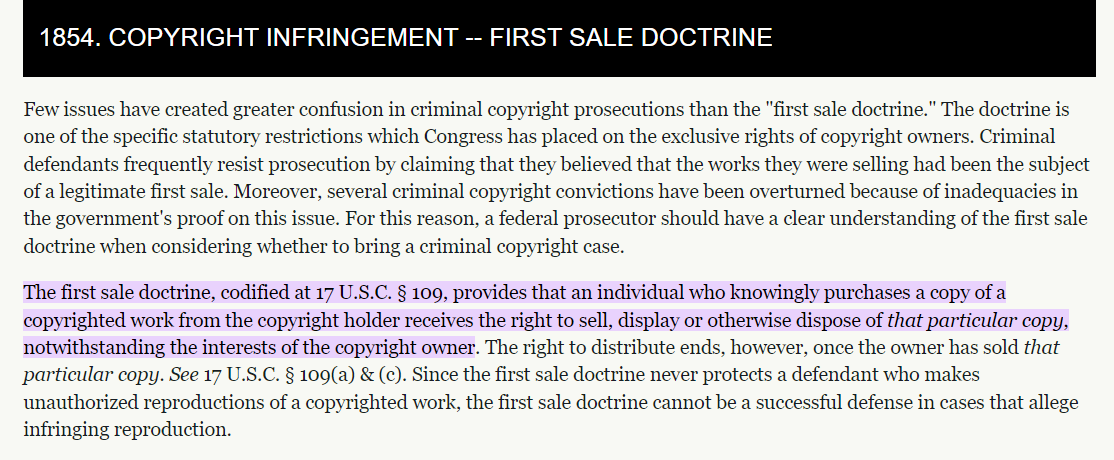
Let’s say you purchased a physical painting (e.g., Monalisa). You now own the painting and can display the painting and even resell the piece, but that doesn’t mean you can reproduce the painting, make copies of it, or make derivatives of it, and so on. In this case, you own the physical painting, but the underlying copyright still lies with the creator. Hence, you may be infringing on the copyright if the use case crosses over to commercial territory. Therefore, the extent of use must comply with the First Sale Doctrine Act, which provides that an individual who knowingly purchases a copy of a copyrighted work from the copyright holder receives the right to sell, display, or otherwise dispose of that particular copy, notwithstanding the interests of the copyright owner (codified at 17 U.S.C. § 109).
It's difficult to see how minting an NFT, even without a license, could be regarded as a copyright infringement from a copyright perspective. The resulting file could not be considered a reproduction or even an adaptation of the work because the NFT is not the work, but rather a string of numbers formed in relation to it. For copyright infringement to take place, three requirements must be met:
The infringer will have taken advantage of one of the author’s exclusive rights without authorization.
There will be a causal connection between the NFT and the original artwork. In other words, the potentially infringing work has to have been created directly from the original.
The work as a whole, or a substantial part of it, will have been copied.
To obtain the complete intellectual property right or copyright, the creator has to expressly state in a contract that they are transferring the said rights when you purchase the NFT. An example is YugaLab’s transfer of IP rights to the holders of BAYC. Apart from that, you can assume that any NFT you buy will only afford you certain rights unless otherwise stated.
To ascertain the rights granted by a particular NFT, you can check the NFT description in the NFT marketplace or the terms of sale, which are usually found on the creator’s website.
Conclusion
Is the NFT you bought actually yours? Ans: Yes.
Is it true that possessing the NFT gives you all rights? Ans: Not all the time, unless otherwise stated.
Is the NFT less valuable as a result? Ans: No.
Great thread. Thanks for sharing